Nebraska Assisted Living Licensing and Regulations Explained
A practical guide to Nebraska licensing, inspections, dementia terminology, complaints, and care costs for families comparing assisted living in Lincoln.
Nebraska assisted living regulations are easier to use when families separate three questions: whether a residence is licensed, what its license actually covers, and whether its services fit one person’s daily needs. A license is an oversight baseline, not a guarantee that a particular building, routine, or care approach will feel right. Cost and payment rules sit alongside that review; they do not replace it.
Prairie View Senior Living of Nebraska is at 3534 S 48th St in southeast Lincoln, in Lancaster County. It offers assisted living and respite care only, not memory care. The dementia discussion below is therefore educational. These steps can help a Lincoln family vet any residence without reading too much into a license or a marketing label.
Nebraska assisted living regulations start with DHHS
In Nebraska, the Division of Public Health within the Department of Health and Human Services, or DHHS, licenses assisted living facilities. The DHHS assisted living licensure guidance says a facility must be licensed before operating or holding itself out as an assisted living facility. That second part matters: a residence should not simply use the assisted living label while leaving its licensing status unclear.
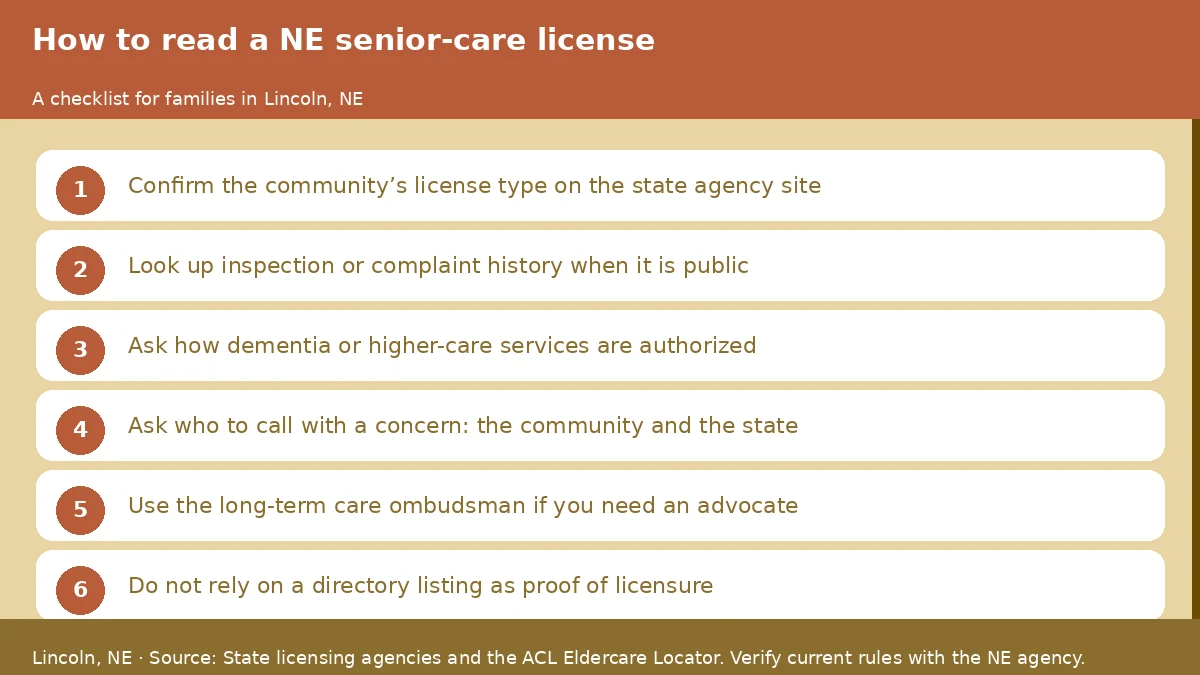
The license name to listen for in this context is “assisted living facility.” That is more useful than broad descriptions such as senior living, retirement community, or care home. Ask for the legal name on the license and confirm that it matches the business name and Lincoln address you were given. DHHS licensure establishes regulatory oversight; it is not a quality rating, an endorsement, or a promise of availability.
What 175 NAC 4 covers and what it does not
DHHS identifies Title 175 Nebraska Administrative Code Chapter 4, often shortened to 175 NAC 4, as the assisted living facility rule chapter. Its stated scope covers operations, care, treatment, and physical plant standards. Those categories give families a framework for questions, but the category names alone do not supply every operational detail.
- Operations: Ask who is responsible for day-to-day management and how concerns are documented.
- Care and treatment: Ask how the residence determines which needs it can support and what happens when needs change.
- Physical plant: Observe entrances, bathrooms, shared spaces, and the areas a resident would actually use.
- Scope: Ask which services are included, which are optional, and which the residence does not provide.
Using Nebraska assisted living regulations well means avoiding assumptions. The broad rule categories should not be turned into invented claims about staffing ratios, inspection frequency, private-room requirements, or dementia programs. Ask DHHS or the residence for the specific provision or policy behind any answer that affects your decision.
How to use licensing and inspection information on a tour
According to DHHS, initial licensure includes document review and an inspection. That statement should not be stretched into a claim that every later inspection follows the same schedule or is unannounced. If timing matters, ask DHHS what the current process is and what records a member of the public may review.
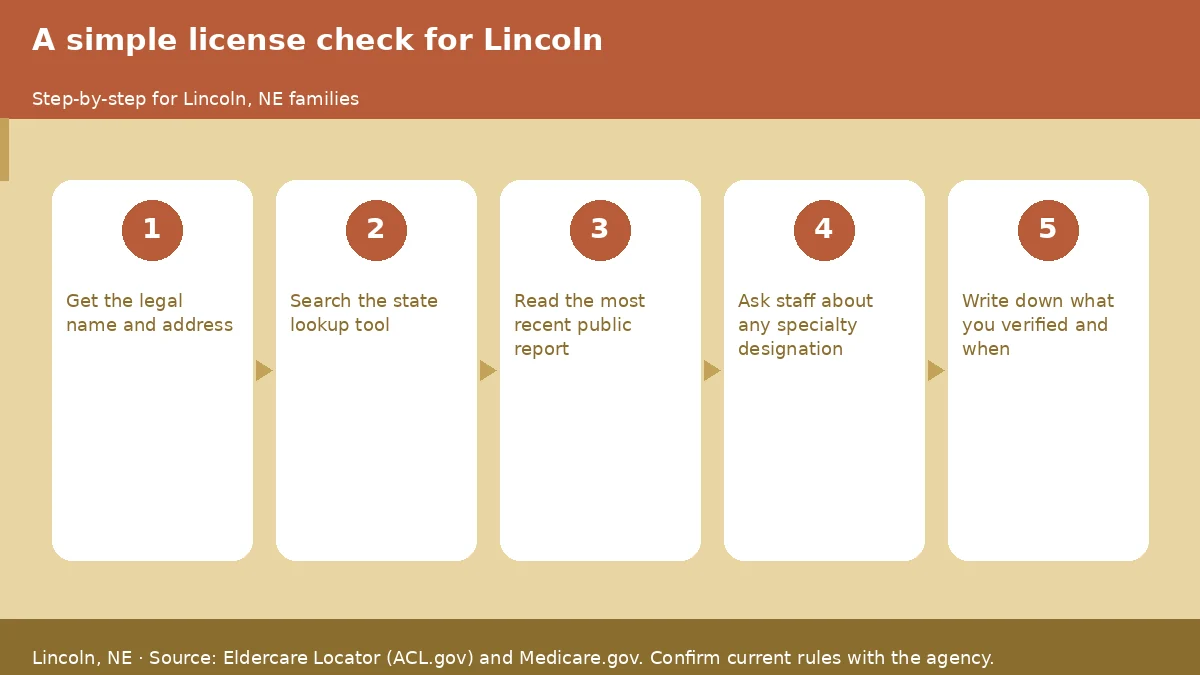
- Confirm the current license status with DHHS, using the legal name rather than a logo or shorthand name.
- Match the licensed location with the street address you plan to visit.
- Ask what inspection information is available and whether any answer needs follow-up with the agency.
- During the tour, connect each claim to a written policy, service description, or clear explanation of who provides it.
- Write down unresolved questions and the name or role of the person who will answer them.
Families comparing assisted living in Lincoln can use the same sequence at every tour. At Prairie View’s S 48th St location, keep the confirmed services distinct from services a family may need to arrange elsewhere. A consistent checklist makes it easier to compare a residence’s actual answers rather than its décor or the pace of a single visit.
Memory care and dementia terms need separate verification
An assisted living license and a dementia-specific service description are not the same question. The DHHS overview cited above identifies general assisted living facility licensure and 175 NAC 4. It should not be used to infer that every assisted living facility offers memory care, or that a particular dementia-related license, secured unit, or staffing model exists. If a residence advertises memory care, ask DHHS which requirements apply and ask the residence to describe its support, supervision, and environment in writing.
Prairie View does not offer memory care, and its respite care should not be described as a substitute for it. The National Institute on Aging explains that respite care gives family caregivers a short-term break and can occur at home, in adult day centers, or during short residential stays. A respite care stay may help a Lincoln family understand routines and care needs over a limited period. It does not convert a residence into a memory care provider.
Where to take concerns and complaints
Start a service concern with the person responsible for the residence’s daily operations, and ask how it will be documented and reviewed. For a licensing concern, contact the DHHS Division of Public Health and ask for the appropriate complaint intake route. Keep a factual record of dates, the concern raised, and the response. Do not assume that a tour conversation, a payment dispute, or a regulatory complaint will be handled through the same channel.
The Eldercare Locator, a service of the U.S. Administration for Community Living, connects families with local Area Agencies on Aging and can be reached at 1-800-677-1116. It can help a Lancaster County family find local aging-services guidance. That resource complements, but does not replace, direct license verification or a complaint to the regulator.
Put Lincoln care costs beside the licensing review
A license tells you that a residence is within a regulatory system; it does not tell you what a month of care will cost. The , based on data collected from July through November 2025, reports these medians and rates for the Lincoln metro area, alongside state and national benchmarks. They are planning figures, not quotes, and they do not describe Prairie View’s prices.
The nursing home figures reflect a different setting and should not be read as assisted living add-ons. Likewise, the in-home comparison uses 44 hours per week; a different schedule changes the comparison. Ask every provider what the quoted amount includes, how changes in needs are billed, and which charges are optional. Contact Prairie View directly for current rates and availability.
Payment eligibility is separate from licensing
Payment eligibility is separate from licensure. Medicare states that it does not cover long-term custodial care when that is the only care needed, and notes that most long-term care is custodial. Families should not assume that a short-term medical benefit will pay an ongoing assisted living bill.
Nebraska’s Medicaid Aged and Disabled Waiver can pay for assisted living services in a participating facility for Nebraska Medicaid members who are age 65 or older, or who have a disability, and who meet nursing facility level of care. Listed services include personal care, help with daily activities, medication assistance, housekeeping, laundry, transportation, and social activities. Participants pay room and board plus any Medicaid share of cost. The waiver also covers in-home services and respite. Eligibility, facility participation, and service authorization are separate questions.
Long-term care insurance may pay for assisted living, depending on the policy. Benefits commonly begin after an elimination period and when the policyholder needs help with activities of daily living or has cognitive impairment; read the actual policy. The VA describes Aid and Attendance as an increased monthly amount added to a VA pension for certain wartime-era Veterans or surviving spouses who need help with daily activities, are bedridden, live in a nursing home because of lost abilities, or have limited eyesight. Current pension rates and financial rules should be checked directly with the VA.
A document-based way to make the decision
A useful decision file fits on a few pages: confirmed license information, notes from DHHS, a written service description, tour observations, current rates, and the payment sources that truly apply. Keep questions about dementia support separate from general assisted living, and keep respite distinct from a permanent move. Neither a higher price nor a polished tour answers a licensing question.
For a Lincoln family, the goal is not to become an expert in every rule citation. It is to know which agency oversees the residence, which claims have been verified, and which details still need a written answer. That steady process supports a clearer comparison while preserving the older adult’s routines, preferences, and dignity.
Frequently asked questions
Who licenses assisted living facilities in Lincoln, Nebraska?
Assisted living facilities in Lincoln are licensed by the Nebraska Department of Health and Human Services, Division of Public Health. DHHS says a facility must be licensed before operating or holding itself out as an assisted living facility. The governing chapter identified by DHHS is Title 175 Nebraska Administrative Code Chapter 4. Ask DHHS to confirm current status using the residence’s legal name and Lincoln address.
Does an assisted living license mean a Lincoln residence offers memory care?
No. The general assisted living licensure overview should not be read as proof that a residence offers dementia-specific services. Ask DHHS which requirements apply to any memory care advertising, and ask the residence to describe its support, supervision, and environment. Prairie View Senior Living of Nebraska offers assisted living and respite care only; it does not offer memory care.
What inspection details should a Lincoln family verify?
DHHS states that initial licensure includes document review and inspection. That does not, by itself, tell a family how often later inspections occur or whether they are announced. During a Lincoln tour, ask for the residence’s legal name, current license information, and what inspection documents are available. Confirm unclear answers with DHHS rather than relying on a brochure or verbal assurance.
How does Lincoln assisted living cost compare with Nebraska?
These are market medians, not Prairie View’s rates, and they do not describe what any particular residence includes. Ask each Lincoln residence for a current written rate schedule and a list of included and additional-charge services.
Can Nebraska Medicaid pay for assisted living in Lincoln?
It can for some eligible people. Nebraska’s Medicaid Aged and Disabled Waiver may pay for assisted living services in a participating facility for Nebraska Medicaid members who are age 65 or older, or who have a disability, and who meet nursing facility level of care. Participants pay room and board plus any Medicaid share of cost. Eligibility, facility participation, and service authorization are separate from DHHS licensure.
Talk with Prairie View Senior Living of Nebraska
If you are weighing care options in Lincoln, call 1-800-592-2807 or contact and tours. Our team can talk through current availability, rates and next steps. Please confirm all details directly, since published figures and listings change over time.
Sources
- VA Aid and Attendance and Housebound benefits
- Medicare: long-term care coverage
- Eldercare Locator (U.S. Administration for Community Living)
- National Institute on Aging: What is respite care?
- ACL: What is long-term care insurance
- Nebraska DHHS: Assisted Living Facilities licensure
- Nebraska DHHS: Services on the Medicaid Aged and Disabled Waiver
Program rules and benefit amounts were checked on the linked official pages in November 2026 and can change.
Related reading on this site: