Signs It's Time for Assisted Living: A Guide for Lincoln Families
A practical guide to recognizing changes, preserving dignity, trying respite care and understanding assisted living costs in Lincoln.
A search for “signs it's time for assisted living Lincoln” often begins after a small change starts to repeat: unopened mail, a bruise with no clear explanation, or a spouse who is too tired to keep doing everything alone. One difficult day does not settle the question. A pattern across personal care, meals, mobility, medication routines, home upkeep and social contact deserves closer attention. The goal is not to take control away from an older adult. It is to understand what has changed, what support would help, and whether that support can still be delivered dependably at home.
Signs it's time for assisted living Lincoln families can observe
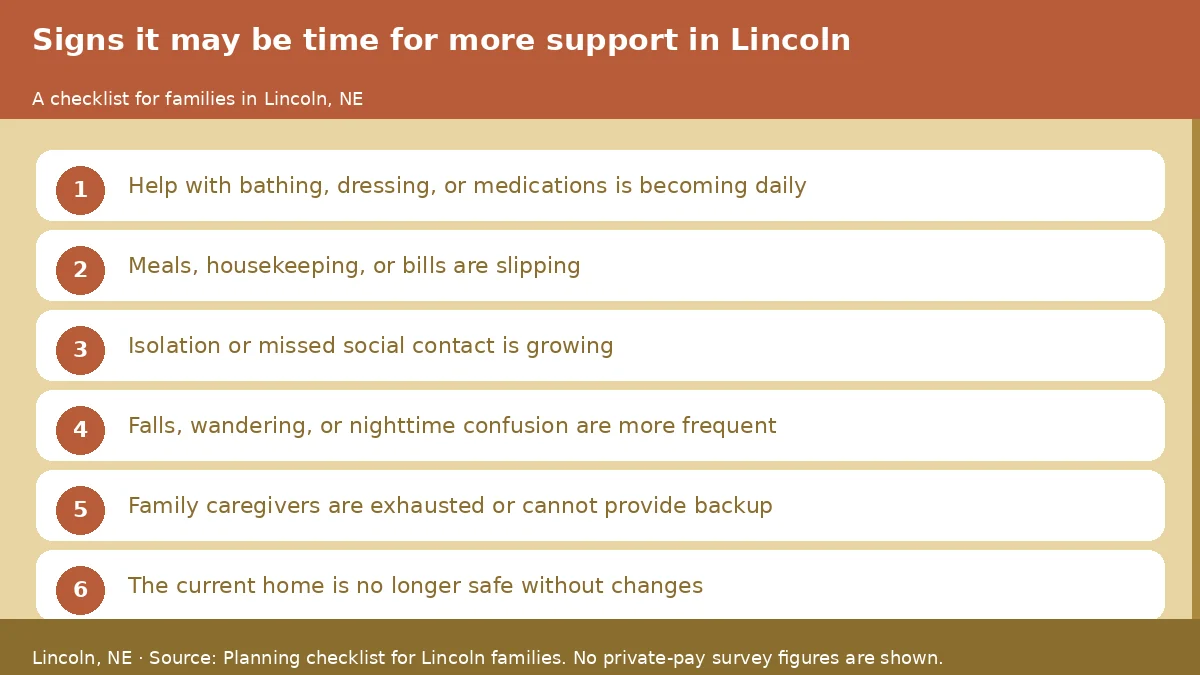
Start with daily function rather than age, a diagnosis or a general sense that someone is slowing down. Notice which tasks the person still does independently, which require prompting and which have quietly become someone else's responsibility. Specific observations are more useful than labels such as frail or stubborn.
Changes in personal care and mobility
Repeated difficulty bathing, dressing, using the toilet, preparing food or getting out of a chair can increase the effort required to remain at home. Look for clothing worn for several days, avoided showers, unexplained weight loss, frequent near-falls or reluctance to move around the house. A fall or sudden change in mobility warrants appropriate professional attention; a move should never be treated as a substitute for evaluating a new problem.
A household that no longer matches the person's abilities
Household clues often appear before someone asks for help. Spoiled food may point to difficulty shopping, cooking or remembering what is available. Laundry piled up, burned cookware, unanswered messages, unpaid bills or neglected basic repairs can show that routines are becoming unmanageable. Consider whether the home itself adds obstacles, such as stairs between the bedroom and bathroom, poor lighting or a bathroom that is difficult to use safely.
Safety, medication and caregiver well-being
Medication concerns deserve the same careful observation. Look for duplicate doses, missed doses, confusion about instructions or an organizer that no longer matches the prescription list. A pharmacist or other appropriate professional can help review the medication routine. The practical question is whether reminders and supervision are dependable throughout the day, not whether a spouse or adult child can occasionally fix a mistake.
- Leaving the stove on or repeatedly having cooking mishaps.
- Getting lost during a familiar errand or becoming disoriented at home.
- Relying on furniture for balance or avoiding necessary trips around the house.
- Missing appointments despite calendars, calls and other reminders.
- Needing increasing nighttime help, leaving a caregiver regularly exhausted.
Social withdrawal matters too. A person may stop calling friends, attending a faith community or joining a familiar neighborhood activity because participation has become physically hard, embarrassing or confusing. At the same time, caregiver strain can show up as lost sleep, irritability, neglected health appointments or an inability to leave the house. Caregiver exhaustion is relevant information, not a personal failure. Safety planning should include the well-being of everyone providing unpaid support.
Start the conversation without taking away dignity
Choose a calm time rather than raising the subject immediately after a fall or argument. Begin with what the older adult wants: remaining independent, avoiding further upheaval, seeing friends or reducing the burden on a spouse. Then describe a few observable changes without exaggeration. Listening may reveal fear about money, loss of privacy or being pressured into a permanent decision.
- Ask which parts of the day feel hardest and what help would be acceptable.
- Share concrete observations, focusing on tasks and safety rather than character.
- Discuss several options, including help at home, adult day services, assisted living and a short respite stay.
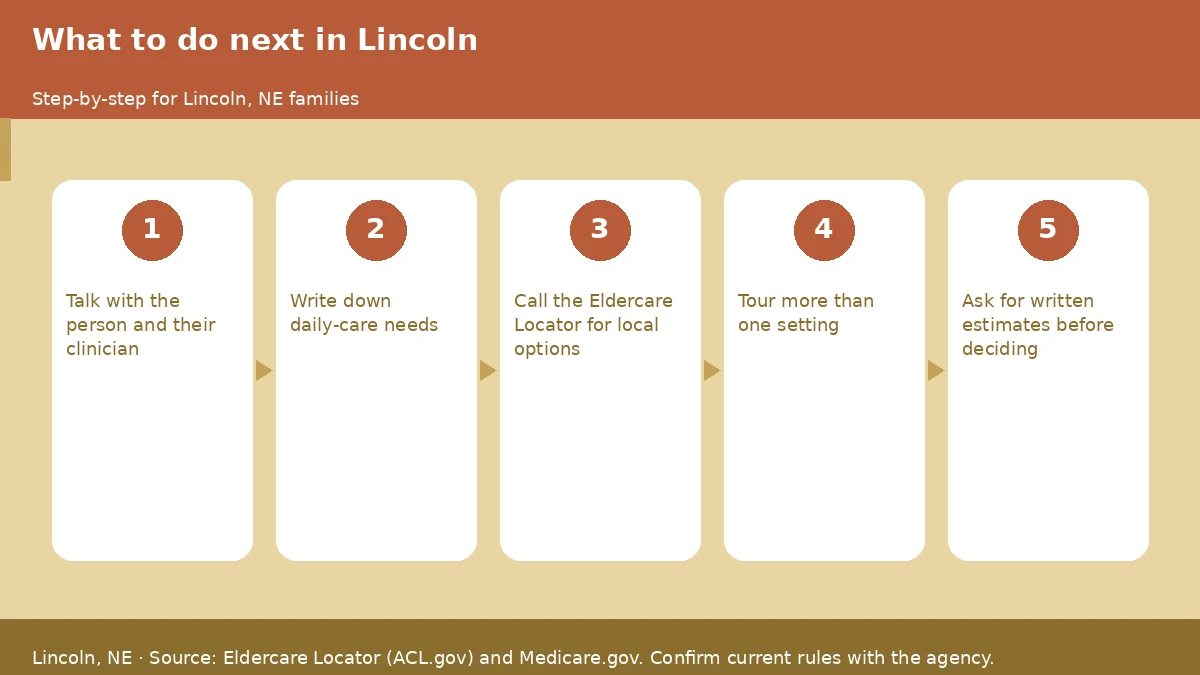
- Agree on a manageable next step, such as a tour, a benefits review or a family meeting.
Include the parent or spouse in tours and decisions whenever possible. Adult children can organize information without speaking over the person who would live there. If family members disagree, the Eldercare Locator from the U.S. Administration for Community Living can connect Lincoln families with their local Area Agency on Aging for information about community services. A neutral professional may also help keep the discussion centered on needs rather than old family roles.
Use a respite stay to gather practical information
A trial stay can make the discussion less abstract. The National Institute on Aging describes respite care as a short-term break for family caregivers, delivered at home, through adult day centers or during short residential stays. It is not a promise that assisted living will suit everyone, and it should not be presented as a trick to obtain a permanent move.
Prairie View Senior Living of Nebraska, at 3534 S 48th St in southeast Lincoln, offers assisted living and respite care, but not memory care. Families can ask about availability, the length of a stay, the assessment process and current rates. If dementia-related supervision is needed, discuss those needs explicitly rather than assuming assisted living or respite care is the right setting.
Before the stay, agree on what everyone hopes to learn. Notice how the older adult manages meals, personal routines, mobility, rest and opportunities for conversation. Ask what felt comfortable and what did not. A difficult first day does not answer every question, just as a pleasant visit does not establish that every ongoing need can be met.
What to look for in a Lincoln assisted living setting
Assisted living generally combines housing with help tailored to daily needs, but communities differ in services, staffing, costs and the level of needs they can support. When learning about assisted living in Lincoln, ask for a written explanation of the assessment, the service plan, medication assistance and what happens if needs increase. Clarify which services are included and which involve additional charges.
The Nebraska Department of Health and Human Services explains that the Division of Public Health licenses assisted living facilities, with initial licensure including document review and inspection. Licensure is a baseline, not a substitute for a family's own visit. Ask about the current license and how care, operations and the physical environment are reviewed.
During a tour, observe whether staff interactions are respectful and whether residents can make ordinary choices. Ask how families receive updates, how concerns are handled and which outside health providers may remain involved. Bring the same questions to each visit. Consistent notes make it easier to compare actual support rather than furnishings or a polished first impression.
What Lincoln cost figures mean for planning
The , using data collected from July through November 2025, provides a useful starting point. Its Lincoln metro figures are used here for Lancaster County planning. A median is the middle of the surveyed results, not a quote for a particular community, and annual figures should not obscure deposits, care-related charges or other terms in an agreement.
Those comparisons help with budgeting, but they do not establish whether a particular move is affordable. Families should build a plan around income, assets, likely care needs and the terms of an actual residence agreement.
These numbers are not predictions about what one person will need. For Prairie View's current assisted living or respite rates, families should call directly and ask what is included.
Review payment sources without assuming coverage
Medicare's long-term care guidance says Medicare does not cover long-term custodial care when that is the only care needed, and most long-term care is custodial. Families should therefore separate payment for ongoing daily support from coverage for a distinct skilled medical service.
Nebraska's Medicaid Aged and Disabled Waiver can pay for assisted living services in a participating facility for eligible Nebraska Medicaid members who meet nursing facility level of care and other requirements. Participants pay room and board plus any Medicaid share of cost. The waiver can also cover certain in-home services and respite. Eligibility and facility participation must both be checked; neither should be assumed.
Long-term care insurance may help depending on the policy. The Administration for Community Living's insurance overview explains that benefits commonly begin after an elimination period and when the policyholder needs help with daily activities or has cognitive impairment. Read the policy and ask the insurer about covered settings, benefit triggers and required documentation.
For eligible wartime-era Veterans and surviving spouses, VA Aid and Attendance can increase a VA pension when specified daily-care or other criteria are met. Current VA pension rates list a maximum annual pension rate with Aid and Attendance of $29,093 for a Veteran with no dependents and $34,488 for a Veteran with one dependent. They are maximum rates, not automatic assisted living payments. The VA net worth limit from December 1, 2025 through November 30, 2026 is $163,699, and countable-income rules matter. Review individual circumstances with the VA or a qualified, accredited representative.
Turn concerns into a workable Lincoln care plan
A list of the signs it's time for assisted living Lincoln families find online is most useful when it leads to a written record of real needs. Note what happened, when it happened, what help was required and whether the current arrangement worked. Include the older adult's priorities and the caregiver's capacity alongside costs and tour notes.
The decision does not have to be rushed into a single yes-or-no answer unless immediate safety requires faster action. A professional evaluation, a benefits review, a tour or a planned respite stay can each clarify the next step. A sound plan preserves choice where possible, states who will provide each kind of help and sets a time to reassess. That approach treats assisted living as one support option, not a verdict on a parent's independence or a family's devotion.
Frequently asked questions
What are the strongest signs that a Lincoln parent may need assisted living?
Look for patterns rather than one bad day: repeated falls or near-falls, difficulty bathing or dressing, spoiled food, unopened bills, medication mistakes, increasing isolation, or a caregiver becoming exhausted. In Lincoln, write down specific examples and discuss them with the older adult and an appropriate professional. Assisted living becomes worth exploring when these needs are persistent and the current plan at home no longer provides dependable support.
How do Lincoln assisted living costs compare with Nebraska?
These are planning benchmarks, not a quote for any particular community. Ask each Lincoln provider what the rate includes, how care needs affect charges, and whether a respite stay is billed differently.
Does Medicare pay for assisted living in Lincoln?
Medicare generally does not pay for long-term custodial care when that is the only care a person needs, and most long-term care is custodial. That means Lincoln families should not assume Medicare will cover an ongoing assisted living stay. Ask Medicare or a qualified benefits counselor about any separate skilled medical need, and review other possible funding sources without treating them as guaranteed.
Can a respite stay help a Lincoln family decide?
Yes. A short respite stay can give a caregiver a break and let everyone observe how the older adult handles meals, personal routines, mobility and social time in a residential setting. Prairie View Senior Living of Nebraska offers assisted living and respite care in Lincoln, but not memory care. Ask about availability, the assessment process, what support is included and current rates before reserving a stay.
What should families ask during a Lincoln assisted living tour?
Ask how the community assesses needs, updates a service plan, supports medication routines and responds when needs change. Request a clear explanation of included services, additional charges, staffing, safety procedures and family communication. Nebraska DHHS licenses assisted living facilities, so ask about licensure as well. Bring the same written questions to each Lincoln tour so comparisons reflect actual needs rather than décor or a first impression.
Talk with Prairie View Senior Living of Nebraska
If you are weighing care options in Lincoln, call 1-800-592-2807 or contact and tours. Our team can talk through current availability, rates and next steps. Please confirm all details directly, since published figures and listings change over time.
Sources
- VA Aid and Attendance and Housebound benefits
- VA pension rates (current)
- Medicare: long-term care coverage
- Eldercare Locator (U.S. Administration for Community Living)
- National Institute on Aging: What is respite care?
- ACL: What is long-term care insurance
- Nebraska DHHS: Assisted Living Facilities licensure
- Nebraska DHHS: Services on the Medicaid Aged and Disabled Waiver
Program rules and benefit amounts were checked on the linked official pages in November 2026 and can change.
Related reading on this site: