Ways to Pay for Assisted Living in Nebraska: A Guide for Lincoln Families
A practical guide to Lincoln costs, private resources, Nebraska Medicaid, VA benefits, insurance, and free guidance for families planning assisted living.
For many Lincoln families, how to pay for assisted living in Nebraska is not a single decision but a sequence of financial, care, and timing decisions. A sustainable plan starts with a written quote, then matches monthly income and available assets to the support needed. It also leaves room for care needs to change. Local cost medians can set expectations, but they cannot determine what a particular community will charge or what public benefits a particular person will receive.
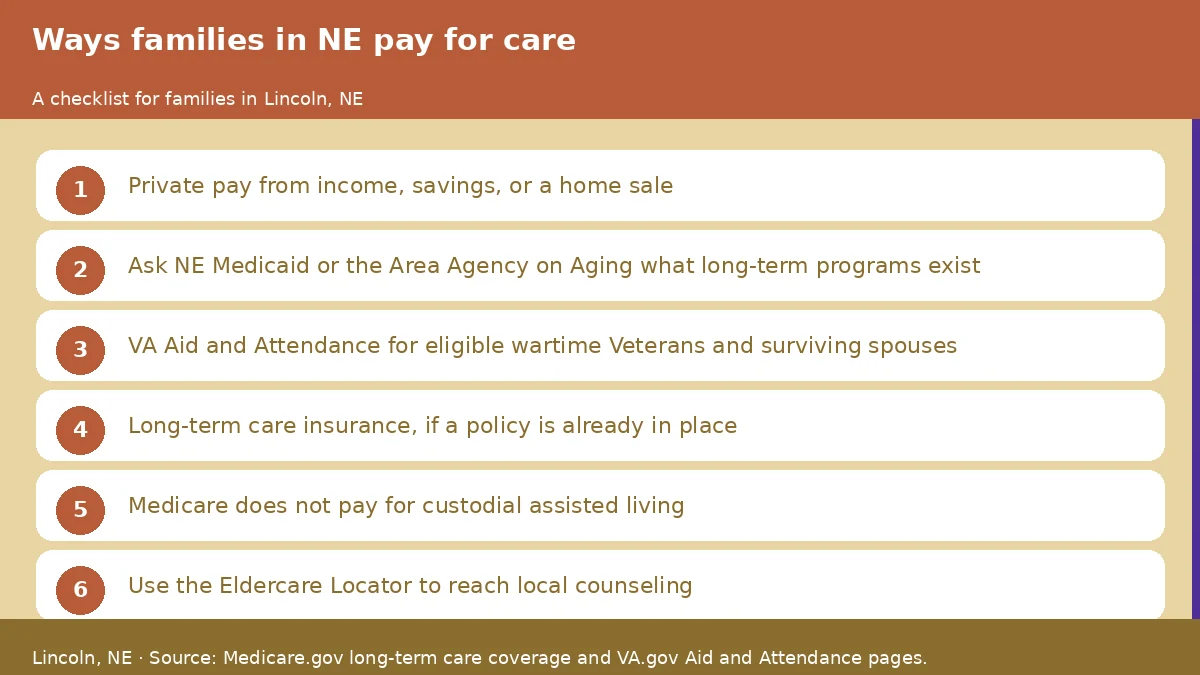
Private savings, home equity, Medicaid, VA benefits, and insurance each follow different rules. Keeping those rules separate helps families avoid building a plan around an assumed benefit.
Start with Lincoln's full monthly cost
Data were collected from July through November 2025.
A median is a market reference point, not a complete household budget. Ask whether a quote covers the apartment, meals, personal care, medication assistance, laundry, transportation, and other services. Also ask how charges are reviewed if support needs change.
Families comparing assisted living in Lincoln should request the same written details from each community. Prairie View Senior Living of Nebraska is at 3534 S 48th St in southeast Lincoln and offers assisted living and respite care. Its prices are not stated here; families can call 1-800-592-2807 for current rates and a written explanation of what is included.
How to pay for assisted living in Nebraska with private funds
Private pay often combines monthly income with savings, investment withdrawals, or proceeds from assets. A useful budget separates reliable monthly income from money that must be drawn down. It also includes expenses that may continue outside the community, such as insurance premiums, taxes, debt payments, or support for a spouse remaining at home. The aim is to see how long the plan can work without assuming that an asset will sell immediately.
Home equity requires particular care. Selling a home can convert equity into cash, while retaining and renting it brings management, maintenance, tax, and vacancy considerations. Borrowing against a home has its own eligibility and repayment terms. Before selling, transferring, or giving away property, consider speaking with a Nebraska elder-law attorney and a tax professional, especially if Medicaid or VA pension benefits may be explored later.
Compare care arrangements on the same monthly basis
Assisted living is not the only cost worth examining. provide reference points for in-home care, adult day health care, and nursing home rooms. The lighter-schedule and around-the-clock in-home amounts below are monthly conversions of the Lincoln hourly rate.
These comparisons do not include every household expense or establish which setting is appropriate.
Scheduled help at home may leave substantial responsibilities with family caregivers. Around-the-clock hourly care is a different financial proposition. Compare supervision, meals, home upkeep, transportation, and caregiver coverage alongside the quoted rates.
Understand Nebraska's Medicaid Aged and Disabled Waiver
Nebraska's Medicaid Aged and Disabled (AD) Waiver can pay for assisted living services in a participating assisted living facility. Eligibility includes Nebraska Medicaid members who are age 65 or older, or who have a disability, and who meet nursing facility level of care. Covered assisted living services can include personal care, help with daily activities, medication assistance, housekeeping, laundry, transportation, and social activities. The waiver also covers certain in-home services and respite.
The waiver does not make the entire community bill disappear. Participants pay room and board plus any Medicaid share of cost. Families should ask for that division in writing rather than treating the waiver as payment for every charge. No Medicaid payment rate should be inferred from private-pay market medians.
Availability and community participation must be checked directly. Ask Nebraska DHHS whether the applicant can enroll, whether a waitlist applies when the application is made, and how that waitlist is managed. Also ask whether the specific community participates. Neither immediate availability nor a current waitlist should be assumed without an answer from the administering program.
Check VA Aid and Attendance and its financial rules
VA Aid and Attendance is an increased monthly amount added to a VA pension. It is not a stand-alone assisted living benefit. Wartime-era Veterans or surviving spouses may qualify under pension rules when they need help with daily activities, are bedridden, live in a nursing home because of lost abilities, or have limited eyesight.
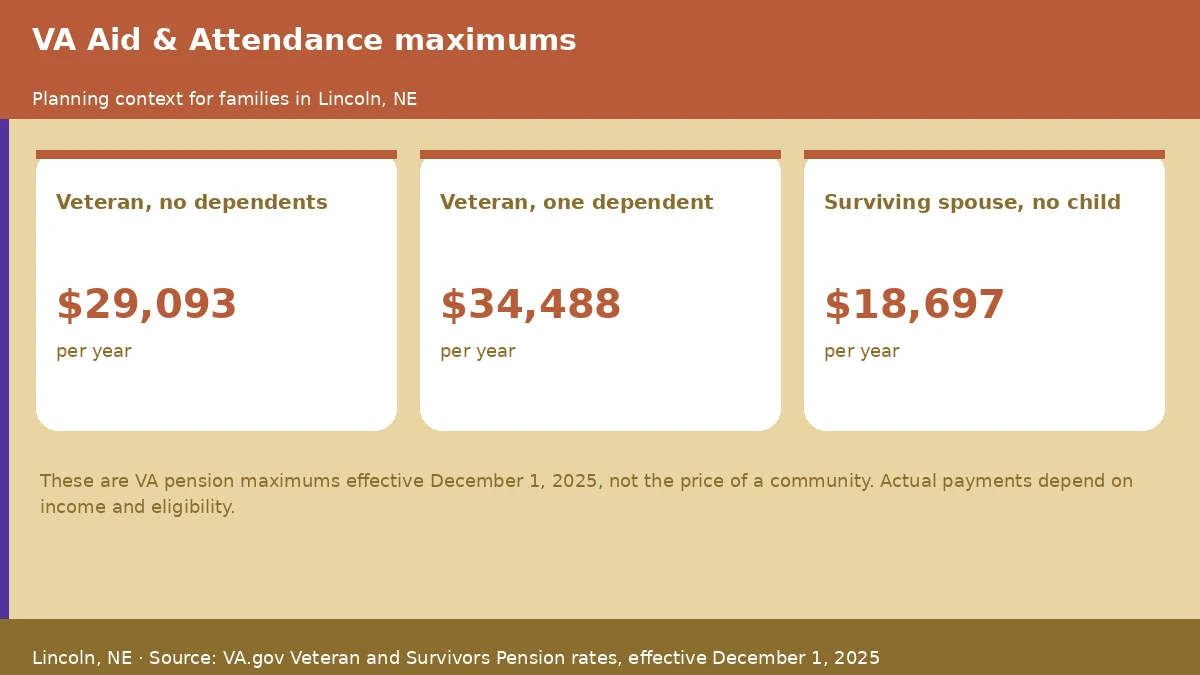
For rates effective December 1, 2025, the Maximum Annual Pension Rate with Aid and Attendance is $29,093 for a Veteran with no dependents. If countable income were zero, that equals a maximum monthly pension of $2,424. These are ceilings before countable income is applied, not standard awards or promises of eligibility.
The VA pension rate rules set a net worth limit of $163,699 for December 1, 2025 through November 30, 2026. Pension is generally the Maximum Annual Pension Rate minus countable income. Unreimbursed medical expenses, which can include care costs, above 5% of that rate can reduce countable income. VA also reviews asset transfers in the 3 years before a claim, and a penalty period can last up to 5 years. Obtain individualized benefits guidance before moving assets or relying on an estimated payment.
Review long-term care insurance and Medicare separately
Long-term care insurance can pay for services such as assisted living, depending on the policy. Benefits usually begin after an elimination period and when the policyholder needs help with activities of daily living or has cognitive impairment. Ask the insurer to confirm the covered settings, benefit triggers, elimination period, payment limits, required documentation, and claim process. Read the policy itself; a similar policy name does not establish identical coverage.
Medicare plays a different role. Medicare's long-term care guidance states that it does not cover long-term care, often called custodial care, if that is the only care needed. Most long-term care is custodial. Medicare should therefore not be budgeted as an ongoing way to pay assisted living room, board, and personal care charges. Health coverage questions and long-term care payment questions need separate answers.
Use respite care while the payment plan takes shape
The National Institute on Aging describes respite care as a short-term break for family caregivers. It can be provided at home, through adult day centers, or during short stays in residential facilities. Prairie View offers respite care in addition to assisted living. Families can ask about current availability, length of stay, included services, and rates without treating a short stay as a commitment to a permanent move.
Respite is not a financing program. Its practical value in this process is time: time to gather benefit documents, compare written quotes, consult advisers, and consider caregiver responsibilities. A short-term arrangement should have its own written service and payment terms.
Get free guidance and verify the details
For families still deciding how to pay for assisted living in Nebraska, the Eldercare Locator is a national service that connects people with local Area Agencies on Aging. Call 1-800-677-1116 and ask for the agency serving Lincoln and Lancaster County. Ask which information, benefits counseling, and caregiver-support services are available at no charge.
State oversight is another part of due diligence. The Nebraska DHHS Division of Public Health licenses assisted living facilities under Title 175 Nebraska Administrative Code Chapter 4. Its standards address operations, care, treatment, and the physical plant, and initial licensure includes document review and inspection. Licensing provides oversight; it does not replace a family's review of services and contract terms.
- Bring each community's written quote and service list.
- Prepare a summary of monthly income, assets, and continuing household expenses.
- Keep the complete long-term care insurance policy available for review.
- Organize VA income, asset, and unreimbursed care-expense records before seeking benefits advice.
- Write down Medicaid waiver participation, enrollment, and waitlist answers, including who provided them.
A careful payment plan combines verified charges with verified eligibility. Keeping written records makes it easier to revisit the plan if income, assets, caregiver availability, or support needs change.
Frequently asked questions
How much does assisted living cost in Lincoln, Nebraska?
A median is not a community quote.
Does Nebraska Medicaid pay for assisted living in Lincoln?
Nebraska's Medicaid Aged and Disabled Waiver can pay for assisted living services in a participating facility for eligible Nebraska Medicaid members. Applicants must be age 65 or older, or have a disability, and meet nursing facility level of care. Participants still pay room and board plus any Medicaid share of cost. Lincoln families should confirm the community's participation and ask Nebraska DHHS about current enrollment and whether a waitlist applies, rather than assuming immediate assistance.
Can VA Aid and Attendance help a Lincoln Veteran pay for care?
Aid and Attendance can increase a qualifying VA pension for wartime-era Veterans or surviving spouses who meet the applicable requirements. For a Veteran with no dependents, the maximum monthly pension figure is $2,424 if countable income is zero; with one dependent, it is $2,874. These are not automatic payments. The net worth limit is $163,699 for December 1, 2025 through November 30, 2026. Countable income, unreimbursed medical expenses, and asset-transfer rules can affect the result.
Will Medicare pay for assisted living in Lincoln?
Medicare does not cover long-term custodial care when that is the only care needed, and most long-term care is custodial. Families should not treat Medicare as an ongoing source of payment for assisted living room, board, and personal care. Separate any questions about health coverage from the community's monthly service charges. Private funds, an applicable insurance policy, Medicaid waiver services, or VA pension benefits may be relevant, depending on individual eligibility and policy terms.
Where can Lincoln families get free help with payment planning?
Lincoln families can call the Eldercare Locator at 1-800-677-1116 and ask for the Area Agency on Aging serving Lincoln and Lancaster County. Ask which information, benefits counseling, and caregiver-support services are available at no charge. Nebraska DHHS is the appropriate state contact for questions about the Medicaid Aged and Disabled Waiver and assisted living facility licensure. Bring written community quotes, income and asset information, insurance documents, and a list of benefit questions to each discussion.
Talk with Prairie View Senior Living of Nebraska
If you are weighing care options in Lincoln, call 1-800-592-2807 or contact and tours. Our team can talk through current availability, rates and next steps. Please confirm all details directly, since published figures and listings change over time.
Sources
- VA Aid and Attendance and Housebound benefits
- VA pension rates (current)
- Medicare: long-term care coverage
- Eldercare Locator (U.S. Administration for Community Living)
- National Institute on Aging: What is respite care?
- ACL: What is long-term care insurance
- Nebraska DHHS: Assisted Living Facilities licensure
- Nebraska DHHS: Services on the Medicaid Aged and Disabled Waiver
Program rules and benefit amounts were checked on the linked official pages in November 2026 and can change.
Related reading on this site: